Beside the sentence
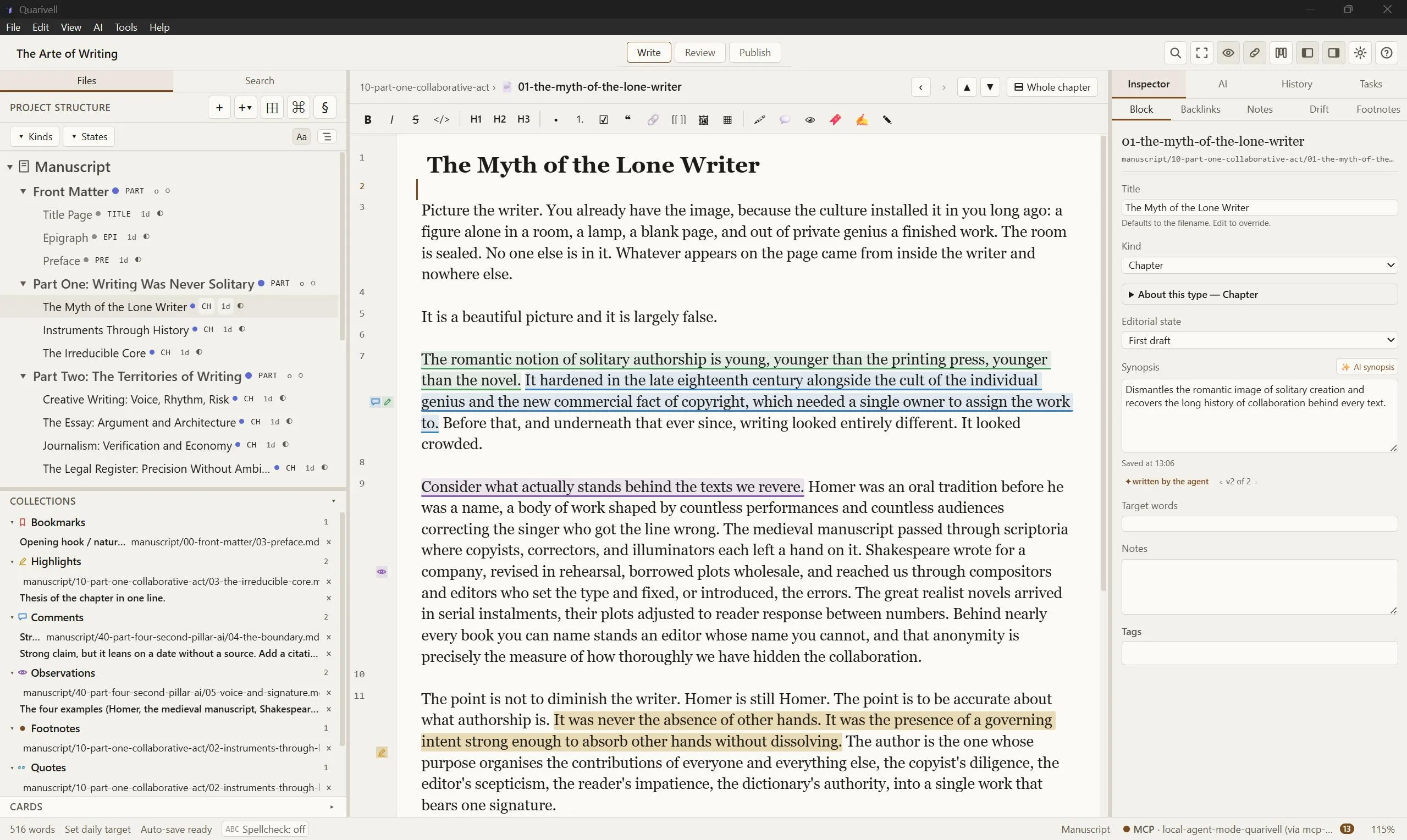
Rewrite a line in your voice and accept it as a diff. Ask about what you are writing, scoped to a selection, a chapter, or the whole project.
The structured writing studio
A desktop workspace for long-form writing and research — from the first idea to the finished manuscript.
Sign up for a 7-day trial — no card.
The process
One tool that follows the work the whole way, instead of three that do not compose.
Three views over one tree. Word targets and cards.
A focused editor and Compose mode. No noise.
Source to citation in one click, cited to the page.
Continuity against your cards. A relationship graph.
Compile to a manuscript DOCX. Your file is never overwritten.
Binder, Corkboard, and Outline are the same structure seen three ways. Cards and targets travel with it.
Binder
▾ Manuscript
I. The Harbor
II. Low Tide
III. The Ledger
IV. Saltworks
▸ Research
Corkboard
Outline view
Research, inside the writing
Read and annotate your sources beside the draft. Ask a question about your own materials and get an answer cited to the file and the page — never an answer from nowhere.
How research works →Grounded answer
You asked
When did the saltworks change hands?
The lease passed to the Veldt family in the spring of 1887, after the harbour court voided the prior claim.
AI, with rules
An accomplice, not an author. It works at three levels around your writing — and the words stay yours.
Rewrite a line in your voice and accept it as a diff. Ask about what you are writing, scoped to a selection, a chapter, or the whole project.
Pull characters, places, and themes into cards. See how they connect. Draft a synopsis for a scene or a folder.
Ask about your own materials and get an answer cited to the file and the page — never an answer from nowhere.
Bring your own key, or keep it on your machine. You see what is sent. Every change is a diff you accept.Your work never trains a model.
How the AI works →↑ Sent to provider
Selected passage (1 paragraph) + your instruction: “tighten this without losing the rhythm.”
⦸ Held back on your machine
the rest of the manuscript · your name · file paths
Owned by you
Your work stays in files you own, readable anywhere, and outlives the app.
In Quarivell
The Salt Road
II. Low Tide — open in the editor
On your disk
~/Books/Salt-Road/
  02-low-tide
— open it anywhereThe structure you know, over a manuscript you can search, version, and submit.
For writers →One workspace for the PDFs, the citations, and the writing — answers cited to the page.
For researchers →A structured workspace for recurring publishing, with no lock-in.
For essayists →Pricing
No subscription in the core. A 30-day trial of the full Pro, with no card, no watermarks, and no save gates.
The thing that pushes me off other tools every six months is that I cannot search or version my own novel. Quarivell adds structure without locking the work away.